
Rugby Betting: How Weather Conditions Affect Handicaps and Total Points
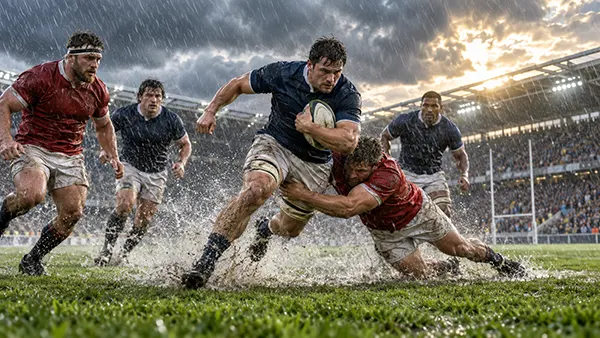
Weather is one of the most visible variables in rugby, yet its effect on betting markets is often oversimplified. Rain does not automatically produce a low-scoring match, just as sunshine does not guarantee an open game with plenty of tries. The useful question is how particular conditions are likely to change possession, handling, kicking, territory and tactical decisions for the two teams involved. Those changes can influence both the handicap and the total-points line. This is especially relevant in rugby union, where teams can score through tries, conversions, penalty goals and drop goals, while scrums, lineouts and territorial kicking can become increasingly important when conditions deteriorate. For bettors, weather therefore works best as one part of a wider match assessment rather than as a reason to back a particular outcome on its own.
Why Weather Can Change the Shape of a Rugby Match
Rain has its clearest influence when it makes the ball and playing surface difficult to manage. A wet rugby ball can be harder to catch securely, transfer quickly and control through repeated phases. That can increase knock-ons, loose passes and interruptions that lead to scrums. Teams that normally build attacks through several quick passes may respond by playing more directly, keeping the ball closer to their forwards or kicking earlier rather than taking unnecessary handling risks. These changes matter to betting because a team priced as a significant favourite may have been given that handicap partly because of its expected attacking superiority. If the weather restricts the type of rugby in which that advantage is strongest, covering a large handicap can become more difficult.
Wind creates a different problem because it affects both scoring attempts and field position. A strong headwind can reduce the useful distance of clearance kicks, while a crosswind can make high kicks, touch-finders, conversions and penalty attempts less predictable. The direction is particularly important. Two teams can experience the same wind during a match but face very different tactical situations in each half. A side playing with a powerful wind may be able to keep its opponent inside its own territory for long periods, whereas the same team may spend much more time defending after the interval. This can produce uneven scoring patterns between the two halves and makes it risky to judge the overall handicap from one short period of dominance.
The condition of the pitch also deserves attention. Heavy rain on a well-drained modern surface may affect the ball without turning the ground into a major obstacle, while persistent rain on a softer natural pitch can influence footing, acceleration and the stability of set pieces. Temperature can matter as well, although it is usually less important to a handicap or points total than significant rain or wind. The practical lesson is that a weather symbol on a forecast is not enough. The intensity and timing of the rain, wind speed and direction, drainage, surface type and the tactical characteristics of both teams provide much more useful information than simply seeing that rain is expected during the match.
Rain and Wind Do Not Automatically Mean Fewer Points
One of the easiest mistakes is to assume that wet weather must produce an under. Rain can reduce the quality of passing and make expansive attacks harder to execute, but it can also create errors close to the try line, poor exits from defensive territory and additional penalty opportunities. A team with a strong scrum, effective maul and accurate short-range kicker may still accumulate points without producing much attractive attacking rugby. A match can therefore look slow and fragmented while still moving towards a respectable total through penalties, maul tries and scores created by territorial pressure. The relevant issue is not whether the weather is bad but how the teams are likely to score when their preferred attacking methods become more difficult.
Wind is equally capable of producing mixed effects. Difficult goal-kicking conditions may remove potential points from long-range penalties and conversions, which can support a lower total. At the same time, a strong following wind can make territorial kicks much more effective and allow one team to repeatedly attack from advantageous positions. Wind can also change decision-making. A captain who believes a penalty attempt is too difficult may choose to kick to touch instead, creating a lineout and possible maul near the opposition try line. That decision exchanges a possible three-point attempt for a chance to score five or seven points, so the relationship between wind and total scoring is not always straightforward.
A real 2026 Premiership example illustrates why context matters. Exeter Chiefs and Bristol Bears played in torrential rain in January, and Bristol won 8-3 in a match where the conditions restricted open attacking play and only one try was scored. That result is consistent with the idea that severe rain can contribute to a low-scoring contest, but one match should not be treated as a betting formula. Team quality, discipline, territory, finishing and tactical choices remain important. Weather can change the probability of particular match patterns; it does not determine the final score before the game begins.
How Weather Should Influence a Rugby Handicap Assessment
A handicap asks one team to win by more than a specified margin or gives the other team a points advantage. Weather matters because conditions can alter how easily a stronger side converts its overall superiority into a large winning margin. Imagine a favourite whose main strength is fast ball from the breakdown followed by width, offloads and repeated attacks through the backs. Persistent rain and a slippery ball can make that style harder to maintain. The favourite may still be the more likely winner, but the probability of turning that superiority into a comfortable margin can decline if the match becomes slower, more territorial and dependent on set pieces.
Low-scoring conditions can make each individual score more important to the handicap. In a match where both sides are expected to score freely, a favourite can concede a penalty or an isolated try and still have plenty of opportunities to rebuild a double-digit lead. When scoring chances are scarce, the same seven points represent a much larger share of the likely final total. This is one reason underdogs can sometimes become more interesting against a large handicap when severe conditions genuinely restrict the favourite’s strongest attacking qualities. It is not enough, however, to see rain in the forecast. A favourite built around forward power, scrum pressure and an effective maul may be just as comfortable in poor conditions as the underdog.
Wind requires another layer of analysis because the handicap can behave differently during separate periods of the match. A side receiving a sizeable advantage pre-match might fall well behind while playing into the wind and then recover territory later when the teams change ends. Conversely, a favourite with the wind may establish a lead that looks dominant without actually demonstrating a large difference in underlying performance. For live betting, the score should therefore be read alongside field position, wind direction and the amount of time each team has spent playing with favourable conditions. The scoreboard alone can give an incomplete picture when one side has spent most of the opening period facing a strong headwind.
Match the Favourite and Underdog to the Conditions
The first team characteristic to consider is where the favourite normally creates its advantage. A side that dominates the scrum, wins lineout possession reliably and drives effectively from mauls may lose less of its strength in wet weather than a team heavily dependent on rapid passing and attacking from deep positions. The same applies to the underdog. If the weaker side has a strong defensive kicking game and is comfortable playing without much possession, poor weather may suit a strategy based on territory and pressure. If its main chance of an upset depends on running from broken play and creating tries from turnovers, persistent rain may remove some of the opportunities it needs.
The quality of the goal kickers can be particularly important in close handicaps. Research based on 582 international rugby union matches and 6,769 goal-kick attempts found that 45% of points in the sample came from goal kicks, illustrating how important kicking can be to the final score. Distance and angle were major influences on success, while professional kickers and coaches have also identified wind, weather and pitch conditions as factors that affect place kicking. A bettor therefore gains more from considering the actual kickers than from making a blanket assumption about the weather. A team with an excellent kicker may be better equipped to keep scoring in difficult conditions, particularly when penalties are available from manageable distances.
Discipline is another factor that becomes increasingly relevant when attacking chances are limited. If one team regularly gives away penalties in its own half, wet weather does not necessarily protect it from conceding points. The opposition may not need long attacking sequences if its kicker can repeatedly turn penalties into three points or if penalties provide access to attacking lineouts. When comparing a favourite and an underdog, recent results should therefore be separated into the elements that created those results: set-piece strength, penalty count, kicking quality, territorial control and attacking efficiency. Weather can amplify some of those strengths and weaknesses while reducing the importance of others.

How Weather Affects Total Points and the Timing of a Bet
Total-points betting requires an estimate of how many scoring opportunities the match is likely to create and how efficiently those opportunities will be converted. Persistent rain may reduce clean possession and make long passing sequences harder, while strong wind can affect goal attempts and tactical kicks. Those factors can support a lower-scoring expectation, particularly when both teams normally rely on wide attacking rugby. However, bettors should also account for the alternative routes to points. Repeated scrum penalties, driving mauls, short-range penalty goals and defensive errors can keep the score moving even when the number of successful attacking phases falls.
The relationship between the handicap and the total can provide useful context. A relatively low expected total combined with a large handicap implies that the favourite is expected to account for a substantial share of the scoring. In difficult weather, it is worth asking whether the favourite has the style required to create that margin without relying on high-tempo attack. The reverse question applies when the total remains high despite a poor forecast. There may be valid reasons for that assessment, such as strong forward attacks, unreliable defences or teams that generate many close-range scoring chances. Weather should therefore be compared with the line rather than assessed separately from it.
Timing matters because forecasts change and betting prices can respond to new information. A forecast several days before kick-off is useful for identifying a possible scenario, but it should not be treated as the final condition report. Rain can arrive earlier or later than expected, while wind speed and direction can change significantly within a few hours. Stadium design can also alter how exposed the playing area is. Checking conditions close to kick-off gives a better picture of what the players will actually face. At the same time, a bettor must consider whether the market has already adjusted. Identifying bad weather is not automatically useful if the total has already fallen far enough to reflect that information.
A Practical Way to Check Weather Before a Rugby Bet
Start with the forecast for the actual stadium and the scheduled kick-off period rather than a general forecast for the city. Rain probability alone provides limited information, so look at expected intensity, duration, wind speed, gusts and wind direction. Then connect those conditions to the teams. Consider whether they prefer to carry or kick from their own half, whether they rely heavily on wide passing, how strong their scrum and lineout are, and who is likely to take kicks at goal. The purpose is to identify a football reason why the conditions could change the expected margin or score rather than assuming that a particular weather symbol automatically supports a bet.
Next, compare the current handicap and total with the numbers available earlier in the betting cycle where that information is available. If the total has already moved substantially after a severe weather forecast, much of the expected effect may already be represented in the price. If conditions improve but the line remains based on an earlier forecast, the opposite situation can occur. The same principle applies to handicaps if bad weather is particularly harmful to one team’s style. Market movement does not prove that the latest price is correct, but ignoring it can lead to betting on an observation that has already been incorporated into the line.
Finally, allow for the possibility that conditions become severe enough to affect the fixture itself. World Rugby regulations permit international matches to be postponed because of adverse weather or the state of the ground, while individual competitions and bookmakers can have their own rules for postponed or abandoned matches and settlement of bets. Those rules should be checked before staking money when serious weather is expected. More broadly, weather is a source of information rather than a guaranteed betting advantage. The strongest assessment combines conditions with team style, selection, kicking quality, discipline, venue and the current price. If several of those factors point in the same direction, the weather has useful context; if they conflict, it is usually a reason for greater caution rather than greater confidence.
Read also
-
Rugby Betting: How Weather Conditions Affect Handicaps an...
Weather is one of the most visible variables in rugby, …
-
 How the IFAB 2026/27 Goal-Kick Countdown Could Change Cor...
The Laws of the Game 2026/27 introduce a small but …
-
 Betting on eSports: Distinctive Features and Strategies
In the modern age of technology, eSports has risen as …
-
 Esports Betting: How to Evaluate a Team’s Map Pool ...
Understanding a team’s map pool is one of the most …