
How the IFAB 2026/27 Goal-Kick Countdown Could Change Corner Betting
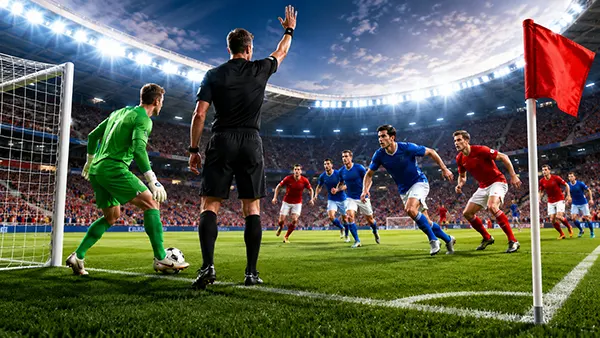
The Laws of the Game 2026/27 introduce a small but potentially important change for anyone who follows football corner statistics. When a referee decides that a team is deliberately delaying a goal kick, the official can now start a visible five-second countdown. If the ball is still not in play when that count ends, the opposing team receives a corner. The rule is primarily intended to reduce time-wasting and keep matches moving, but it also creates a new route by which corners can occur without being generated by a blocked shot, defensive clearance or other attacking action. That does not mean corner totals will suddenly rise in every competition. Referees retain discretion over when the countdown begins, and teams can adapt quickly. For corner betting, however, the change adds a factor that was largely absent from older statistical models and deserves attention during the 2026/27 season.
What the Five-Second Goal-Kick Rule Actually Changes
The most important point is that there is no automatic five-second limit attached to every goal kick from the moment the ball goes out of play. Under Law 16 and the accompanying IFAB countdown protocol, the referee first has to decide that the team taking the goal kick is unfairly or deliberately delaying the restart. The official can initially use a whistle or verbal instruction to encourage the player to continue, although this warning is not compulsory. Once the countdown is formally started, the referee blows the whistle, clearly signals that the restart should be taken and visibly counts down five seconds with a raised hand. A verbal count may also be used where appropriate. If the ball is put into play before the count expires, the match continues normally and no additional sanction is applied.
If the team fails to restart play within the countdown, the consequence is considerably more relevant to corner statistics than the traditional methods of dealing with minor delays. Instead of simply adding time, repeating an instruction or immediately issuing a yellow card, the referee awards a corner to the opposing team. The corner is taken on the side of the pitch closest to the position from which the goal kick was due to be taken. The player responsible is not automatically cautioned for exceeding the countdown. A yellow card becomes relevant only if that player or a team-mate subsequently causes an excessive delay to the opposition’s corner. The design of the rule therefore focuses on changing the restart itself rather than automatically adding a disciplinary punishment.
The Laws also give referees some freedom to identify delaying behaviour before a player is actually standing over the ball. The countdown can be triggered when somebody slowly retrieves the ball or deliberately places it incorrectly for the goal kick. That detail matters because the effective period of scrutiny is wider than five seconds after the ball has been positioned. At the same time, IFAB states that a player should not be punished when clearly in the process of kicking the ball as the count reaches its end. The 2026/27 Laws became effective from 1 July 2026, with earlier implementation possible for competitions already beginning before that date, and the changes were also introduced for the 2026 FIFA World Cup. Bettors assessing the rule should therefore focus on actual referee enforcement rather than treating five seconds as a mechanical timer applied to every restart.
Why the New Sanction Matters Specifically for Corner Markets
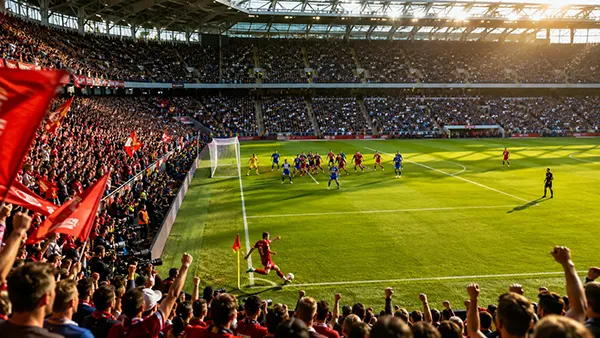
Traditionally, most corners originate from attacking pressure: a shot is deflected behind, a defender blocks a cross over the goal line or a goalkeeper pushes the ball around the post. The new sanction introduces another category. A team can now receive a corner without having produced the attacking action normally associated with one. From a betting perspective, this matters because historical corner data mainly describes tactical and territorial events. Models often use possession, shots, crossing frequency, attacking width, defensive blocks and previous corner rates to estimate future totals. A procedural corner caused by a delayed goal kick has a different origin. It reflects match management and refereeing rather than the attacking quality of the team receiving it.
The scale of the effect should not be exaggerated. A five-second countdown is intended as a deterrent, and the most successful version of the rule may actually produce relatively few sanctions. Once players understand that delaying a goal kick can give the opposition an attacking set piece, they have a strong reason to restart more quickly. A team protecting a one-goal lead gains little from saving a few seconds if the possible cost is a corner delivered directly into its penalty area. This behavioural response is why it would be premature to add a fixed amount, such as half a corner or one corner, to every pre-match projection. The effect is more likely to vary between competitions, referees, teams and particular match situations.
There is also an important distinction between this change and the goalkeeper possession rule introduced for 2025/26. Under that earlier amendment, a goalkeeper who controls the ball with the hands or arms for more than eight seconds can concede a corner, with the referee visually counting the final five seconds. The 2026/27 goal-kick provision deals with a different phase: the ball is already out of play and the team is delaying the restart. Both offences can therefore produce a corner, but they should not be combined into a single statistical category when analysing matches. One relates to a goalkeeper retaining possession after collecting the ball; the other relates to delaying a goal kick before the ball returns to play. Keeping those situations separate makes it easier to judge whether changing corner numbers are actually linked to the new restart rule.
Where Corner-Betting Patterns Could Shift in 2026/27
Total-corners markets are the most obvious area to watch because every enforced goal-kick sanction creates an additional opportunity for a corner to be taken. Yet the effect is unlikely to be evenly distributed across 90 minutes. Match context matters. A side chasing a goal has little incentive to delay its own goal kicks, particularly late in the match. A team protecting a narrow advantage has a stronger reason to slow the tempo, reorganise its shape and reduce the opponent’s available attacking time. That makes the final stages of close matches a logical area to monitor. If referees enforce the protocol consistently, some corners that previously would never have occurred could appear precisely when defending teams are under the greatest pressure to manage the clock.
Team-corner markets could also be affected in a less obvious way. Suppose a strong attacking side is trailing against an opponent defending deep. Traditional analysis might already expect the chasing team to collect corners because of territorial pressure and repeated crosses. The countdown rule creates a second possible source of corners in the same match state: the defending team may also be more tempted to delay goal kicks. The two effects can reinforce one another. However, the same logic does not apply automatically when the favourite is comfortably ahead or when both sides are satisfied with the score. Using league-average corner figures without considering scoreline behaviour may therefore become slightly less informative than examining how teams manage restarts in different situations.
Live corner betting may react more quickly than pre-match markets because the relevant behaviour can be observed during the game. Bettors can see whether a goalkeeper is repeatedly slowing restarts, whether the referee is giving verbal warnings and whether a visible countdown has already been used. That information did not exist in the same form in older matches. Even so, one warning should not be treated as proof that a corner sanction is imminent. The official still decides when a delay becomes unfair, and a team that has been warned once may simply restart more quickly afterwards. Live analysis should therefore distinguish between evidence of stricter enforcement and an assumption that the same offence will be repeated.
Match Situations Most Likely to Create Countdown Risk
Late-game scorelines provide the clearest theoretical reason for increased countdown risk. When a team leads by one goal with only a few minutes remaining, reducing the opponent’s rhythm becomes tactically valuable. Goalkeepers have traditionally been involved in this type of game management because goal kicks provide a natural pause in which defenders can move up the pitch and the team can reorganise. The 2026/27 sanction changes the risk attached to that behaviour. An excessive delay no longer merely consumes time while inviting a warning. It can hand the chasing team a corner and put the defending side immediately under pressure. Coaches therefore have an incentive to change established habits, especially in knockout matches or league fixtures where protecting a narrow lead has high value.
Frequent goal kicks are another variable worth recording, although they should not be confused with actual countdown offences. A team cannot concede a corner through this rule unless it first has a goal kick to take, so matches containing many goal kicks naturally provide more possible situations in which a delay could occur. That does not make a sanction probable. A goalkeeper who consistently restarts quickly may face no countdown at all despite taking ten or more goal kicks. For useful analysis, raw goal-kick volume needs context: scoreline, minute, the pace at which the team normally restarts and the referee’s response to earlier delays all matter more than the number by itself.
Refereeing style may become another practical variable during the first months of the rule. IFAB supplies a clear procedure once a referee decides that deliberate delay is taking place, but the initial judgement is still subjective. Some officials may intervene after relatively brief and obvious attempts to waste time, while others may prefer an instruction before beginning the formal countdown. Competition guidance and referee briefings may gradually reduce those differences. Until a meaningful sample has developed, however, it is sensible to treat referee tendencies as supporting information rather than a reliable standalone betting angle. A handful of matches is not enough to show that one official will consistently produce more countdown-related corners over an entire season.
How Bettors Should Adjust Their Analysis Without Overreacting
The safest way to account for the new rule is to separate confirmed effects from possible effects. The confirmed part is straightforward: deliberate delay at a goal kick can now result in an opposition corner after the referee’s five-second countdown. What remains uncertain is how often this will happen over a full domestic season and whether it will move average corner figures enough to matter consistently. Historical data remains useful because tactical style, crossing volume, attacking territory and defensive behaviour will continue to generate the overwhelming majority of corners. Rather than discarding those numbers, bettors can add countdown incidents as a new variable and compare 2026/27 results with earlier seasons once the sample becomes large enough.
It is particularly important not to judge the rule solely by the first unusual incidents shown in broadcasts or shared online. New football laws attract attention precisely because early examples are unfamiliar, but a memorable sanction does not establish a league-wide trend. A better approach is to record how many formal goal-kick countdowns occur, how many actually reach zero and how frequently teams change their behaviour after receiving a warning. It is also useful to separate the first half from the closing stages because incentives to delay are not constant throughout a match. After several months, those observations can show whether the rule is adding meaningful corner volume or mainly succeeding as a deterrent.
The effect should also be assessed separately for different competitions. Referee instructions, playing styles and the amount of tactical time management are not identical across domestic leagues, international tournaments and lower divisions. A pattern seen during a short international competition cannot automatically be transferred to a 38-match league season. The same applies to individual clubs. One team may traditionally restart quickly from goal kicks, while another may use slower restarts to allow its shape to move up the pitch. The 2026/27 change makes those behavioural details more relevant, but they need to be observed rather than assumed. Reliable betting analysis should remain based on repeated evidence, not on the existence of the rule alone.
Settlement Rules and Early-Season Data Deserve Extra Attention
Bet settlement creates another practical issue because an awarded corner and a taken corner are not always treated as the same event. For example, bet365’s UK football rules state that its standard corner markets are generally settled using corners actually taken, and an awarded corner that is never taken does not count. William Hill also states in its general football rules that an awarded but untaken corner does not normally count, although particular short time-period markets can use different definitions. This distinction matters if a countdown expires near half-time or full-time and the referee awards a corner but ends the period before it is taken. The Laws determine which restart is awarded; the bookmaker’s published market rules determine how the bet is settled.
The same issue can affect live timing. A corner may be awarded in one minute and taken in the next, which can matter for markets limited to a particular time interval. A countdown-generated corner makes this distinction especially noticeable because the award itself is caused by a procedural offence rather than by the ball crossing the goal line. Bettors should therefore check the exact wording for total corners, first or next corner, time-band markets and team corners instead of assuming that every operator uses the same event timestamp. Rules can also differ between ordinary corner markets and special products offered for short periods of play. Checking settlement terms before placing a bet is more reliable than trying to resolve the definition after the match.
The five-second goal-kick countdown is therefore meaningful for corner betting, but its real importance will be determined by enforcement and player adaptation rather than by the wording alone. It introduces a genuine new source of corners and may be most relevant when teams are protecting narrow leads, managing late-game tempo or repeatedly delaying restarts. At the same time, the rule is designed to discourage exactly that behaviour, so a low number of actual sanctions would not mean it has failed. For 2026/27 analysis, the useful approach is to monitor formal countdowns, match context and settlement rules while keeping established corner indicators in place. No rule change makes corner outcomes predictable, and betting decisions should remain proportionate to a fixed personal budget rather than being increased simply because a new statistical angle has appeared.
Read also
-
 Esports Betting in 2026: How Best-of-Three and Map Picks ...
Esports betting in 2026 is increasingly difficult to assess from …
-
 Rugby Betting: How Weather Conditions Affect Handicaps an...
Weather is one of the most visible variables in rugby, …
-
How the IFAB 2026/27 Goal-Kick Countdown Could Change Cor...
The Laws of the Game 2026/27 introduce a small but …
-
 Betting on eSports: Distinctive Features and Strategies
In the modern age of technology, eSports has risen as …