
Betting on the First Goal in Ice Hockey: Starting Line-ups and Power Plays
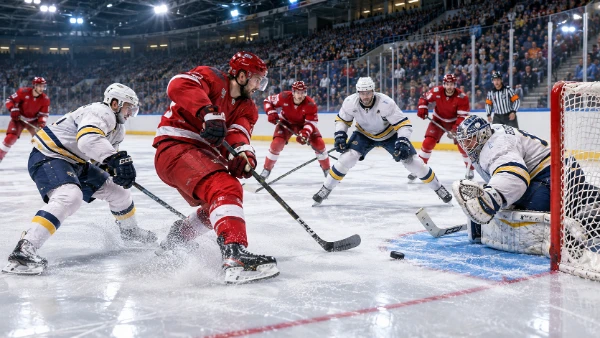
The first goal in an ice hockey match can arrive within seconds of the opening face-off or remain elusive for much of the first period. For bettors, predicting which team will score first involves more than comparing league positions or identifying the stronger attack. Starting line-ups, the way coaches match their players against opponents, and the effectiveness of power-play units can all influence early scoring opportunities. A team that dominates possession may struggle against a well-organised defensive line, while an early penalty can completely change the balance of play. Understanding these situations helps explain how first-goal betting markets work, which statistics deserve attention and why the opening minutes often reveal information that pre-match odds cannot fully capture.
How Starting Line-ups Influence the First Goal in Ice Hockey
Ice hockey teams normally begin a match with three forwards, two defencemen and a goaltender. The five outfield players form the starting unit, although coaches can change their combinations throughout the game. The opening selection matters because these players are responsible for the first face-off, the initial attempt to establish possession and the earliest attacking or defensive exchanges. Some coaches favour their most productive attacking line, while others select a defensively reliable combination to counter the opposition’s leading scorers. As a result, the strongest team on paper does not necessarily begin with its most dangerous offensive players on the ice.
The composition of the starting five can reveal how a coach intends to approach the opening exchanges. A line featuring quick forwards who pressure opponents aggressively may generate turnovers in the attacking zone, leading to shots before the defending team has established its structure. Alternatively, a combination built around experienced defensive forwards may concentrate on preventing mistakes and controlling the neutral zone. Neither approach guarantees the opening goal, but the contrast becomes relevant when comparing teams with different playing styles. Bettors should also distinguish between the starting five and the first power-play unit, as these combinations frequently include different players.
Changes to the starting line-up become especially important when a regular centre, leading goalscorer or established defensive partner is unavailable. A replacement centre may have a different face-off record, while an unfamiliar defensive pairing can require time to adjust to positioning and communication. However, the absence of one prominent player should not automatically be treated as evidence that a team will concede first. Coaches can compensate by changing line assignments or distributing responsibilities across several combinations. For first-goal analysis, the useful question is how the replacement affects the team’s opening shifts rather than simply how many points the missing player has accumulated during the season.
Face-offs, Early Pressure and Match-ups Between Lines
The opening face-off provides the first opportunity to gain possession, but winning it is only a small part of creating an attacking chance. A centre who wins the puck backwards allows the defencemen to organise the first movement, while supporting forwards can accelerate through the neutral zone and establish possession near the opposition’s goal. Teams that coordinate these movements effectively may produce early territorial pressure. Nevertheless, an opening face-off victory does not automatically translate into a shot, and even sustained possession does not guarantee a goal. Face-off statistics are therefore more useful when assessed alongside offensive-zone entries, shot quality and the ability to recover loose pucks.
Match-ups between opposing lines can also affect the opening minutes. A fast attacking trio may encounter difficulties against mobile defencemen who maintain narrow gaps and prevent controlled entries into the offensive zone. Conversely, a defensive pairing that struggles under pressure may provide an opportunity for opponents who forecheck aggressively. Home teams in the NHL generally benefit from the last-change procedure during stoppages, giving their coaches greater control over certain match-ups. However, this advantage does not mean that the home side automatically controls every shift, particularly when players change while play continues. The actual combinations on the ice remain more informative than the home designation alone.
Consider a hypothetical match in which Team A starts with its leading scoring line, while Team B opens with a defensive unit designed to limit space around the slot. Team A may be more likely to generate possession and attempt several early shots, but those opportunities could come from difficult angles. Meanwhile, Team B might create one dangerous counterattack following a turnover. This distinction explains why shot volume and scoring probability are not identical. When assessing the first-goal market, it is worth examining where a team creates chances, which players are involved and whether its opponents regularly allow high-quality attempts during their opening shifts.
The Influence of Power Plays on First-Goal Betting
A power play occurs when a team gains a numerical advantage because an opponent receives a penalty that reduces its number of skaters. Under the usual two-minute minor penalty in the NHL, the penalised team generally plays with four skaters against five, provided no other penalties alter the situation. This creates additional passing space and allows the attacking side to establish possession more comfortably. If the penalty occurs before either team has scored, it can substantially change the immediate prospects of the opening goal. However, the advantage remains temporary, and a team with an effective penalty-killing unit may withstand the pressure without conceding.
Power-play efficiency is commonly expressed as the percentage of opportunities on which a team scores. For example, a club recording 24 goals from 100 power-play opportunities has a conversion rate of 24%. This is useful for comparing special-teams performance, but it should not be interpreted as a 24% probability of scoring the first goal in any particular match. The first-goal outcome also depends on whether an early penalty occurs, which players are available, how much time remains in the advantage and whether either side scores beforehand. A strong power play becomes relevant only when the match provides an opportunity to use it.
Penalty killing is equally important when assessing the opposition. A team that limits shots from central areas, clears the puck consistently and wins defensive-zone face-offs can reduce the danger created by an opponent’s numerical superiority. Goalkeeper performance also matters because even an organised penalty kill may allow difficult saves to become necessary. Bettors should consider both sides of the situation rather than relying exclusively on the attacking team’s conversion rate. The combination of an effective power-play unit and a vulnerable penalty kill may favour the team with the extra skater, but it cannot establish whether that advantage will actually occur before the first goal.
Power-Play Units, Penalty Timing and Shorthanded Goals
Most NHL teams prepare specialist combinations for power-play situations. The leading unit commonly includes creative forwards, a reliable distributor and players capable of shooting through defensive traffic. One player may operate close to the blue line while others position themselves near the face-off circles, behind the net or in front of the goalkeeper. These arrangements help create passing lanes and force defenders to make difficult choices. A dangerous power-play unit is not necessarily composed of the five highest-scoring players, as successful combinations also depend on puck movement, positioning and the ability to recover rebounds. For first-goal bets involving individual players, it is particularly useful to know who receives regular power-play minutes.
The timing of a penalty can affect its relevance to first-goal betting. An infringement committed after 90 seconds may give one team an early opportunity to attack with an extra skater while the score remains level. A penalty assessed after the opening goal has already been scored is irrelevant to a pre-match first-goal selection. The same distinction applies when comparing historical penalty statistics. A team may take numerous penalties across complete matches without regularly being shorthanded during the opening minutes. Examining when penalties occur offers a more meaningful indication of early-match exposure than relying solely on the average number of penalty minutes.
Numerical superiority does not eliminate the possibility of conceding. Teams killing penalties can create shorthanded chances when they intercept a risky pass or exploit an attacking player positioned too far forward. An aggressive power-play formation may therefore produce opportunities at both ends. Under standard NHL rules, a goal scored by the team on the power play usually ends an opponent’s minor penalty, whereas a shorthanded goal does not automatically end that penalty. The distinction matters when analysing the flow of a match, although the first-goal market is settled once the qualifying opening goal occurs. Bettors should avoid treating an early power play as a guaranteed scoring event or assuming that only the team with five skaters can score.

How to Evaluate First-Goal Betting Markets in 2026
First-goal betting generally involves predicting which team will open the scoring, although bookmakers may also offer markets covering the first individual goalscorer or the time of the opening goal. These selections require different assessments. Predicting the first team to score involves overall attacking strength, defensive organisation and the likely flow of play. Selecting the first goalscorer places greater emphasis on an individual’s shooting opportunities, ice time and role in the attacking structure. A player can be an excellent goalscorer without being the most likely person to score first, particularly if another line receives more opportunities during the opening stages.
Historical results can help establish a starting point. The number of matches in which a team has scored first, its first-period goals for and against, and its power-play and penalty-killing records provide useful context. The NHL publishes official team statistics covering goals by period and special-teams performance, allowing bettors to compare complete seasons with more recent results. However, a record of scoring first in 12 of 20 matches does not mean the team has a fixed 60% probability of repeating that outcome against every opponent. The sample includes different goalkeepers, schedules, injuries and opposition strengths, all of which can influence the results.
Price evaluation is another essential part of the process. Decimal odds of 1.80 represent an implied probability of approximately 55.6% before accounting for the bookmaker’s margin, while odds of 2.20 correspond to approximately 45.5%. If two opposing selections are offered at those prices, their combined implied probability exceeds 100%, reflecting the margin included in the market. Identifying a plausible favourite is therefore not enough to establish that a bet offers reasonable value. The available price must also be compared with a defensible assessment of the actual likelihood of the outcome, while recognising that hockey results contain substantial uncertainty.
A Practical Approach to Pre-Match and Live Betting
Before the opening face-off, a useful assessment begins with checking confirmed team news and the expected starting goalkeeper. The next step is to examine the likely forward lines, defensive pairings and first power-play combinations. Recent first-period scoring records can provide context, but should be interpreted alongside the strength of the opposition and the availability of regular players. A team missing its leading centre may struggle to establish early possession, while a replacement goalkeeper could alter the defensive approach. None of these factors should be assessed in isolation. Their combined effect is more relevant than any single headline statistic.
For example, imagine Team A has scored first in seven of its previous ten matches and Team B has conceded the opening goal in six of its last ten. These records may initially favour Team A, but the conclusion becomes less convincing if its leading attacking line is unavailable or Team B has recently strengthened its defensive combinations. If Team A is priced at 1.65, the implied probability is approximately 60.6%, making the available odds another important consideration. The historical figures alone cannot establish whether that price is justified. A sensible assessment would also consider the opposition faced during those matches, the confirmed line-ups and whether the teams’ recent performances reflect their current playing strength.
Live betting allows further observations once the teams begin playing. Early attacking-zone possession, the quality of scoring chances, the performance of the starting lines and penalties can change the assessment made before the match. However, live prices also react quickly, and a promising opportunity may disappear before a bet can be placed. A brief spell of pressure should not be mistaken for proof that a goal is imminent. Market settlement rules also require attention: some operators include overtime in first-goal markets, while others settle particular selections using regulation time only; shootout goals are generally excluded from individual first-goalscorer markets. Checking the exact market conditions, setting a fixed spending limit and avoiding attempts to recover previous losses are more reliable practices than chasing an opening goal based on short-term momentum.
Read also
-
Betting on the First Goal in Ice Hockey: Starting Line-up...
The first goal in an ice hockey match can arrive …
-
 Esports Betting in 2026: How Best-of-Three and Map Picks ...
Esports betting in 2026 is increasingly difficult to assess from …
-
 Rugby Betting: How Weather Conditions Affect Handicaps an...
Weather is one of the most visible variables in rugby, …
-
 How the IFAB 2026/27 Goal-Kick Countdown Could Change Cor...
The Laws of the Game 2026/27 introduce a small but …